

The Voice of the Hemisphere — Opinion
How many years have Cubans been waiting for a convincing explanation of what happened under President John F. Kennedy and the failure of the Bay of Pigs?
In my opinion, for decades this episode has been told through a version that does not allow us to fully understand the political decisions, the intelligence operations and the interests surrounding those events.
A nation that had placed its hopes in an operation meant to end Fidel Castro’s communist regime demanded answers. Yet the story of the Bay of Pigs cannot be separated from the activities of the Central Intelligence Agency (CIA) or from the contradictions between the security agencies and presidential power.
From the OSS to the CIA: two different eras
The Office of Strategic Services (OSS), created in 1942 under President Franklin D. Roosevelt and led by William J. Donovan, played an important role in World War II. Its members took part in intelligence, espionage and special operations missions against the Axis powers, and contributed to the war effort of the United States and its allies.
The OSS was dissolved in 1945. Two years later, under President Harry S. Truman, the CIA was created. Although both organizations are part of the historical evolution of American intelligence, their actions must be examined separately.
It is precisely in the decisions and operations of the CIA during the Cold War that we must focus our analysis of the Bay of Pigs, Operation Mongoose and the events surrounding the Kennedy presidency.
The Bay of Pigs: a defeat that marked history
Under President Dwight D. Eisenhower, preparations began for a covert operation against Fidel Castro. John F. Kennedy inherited that project and authorized it in April 1961, on the condition that there be no open involvement of U.S. forces.
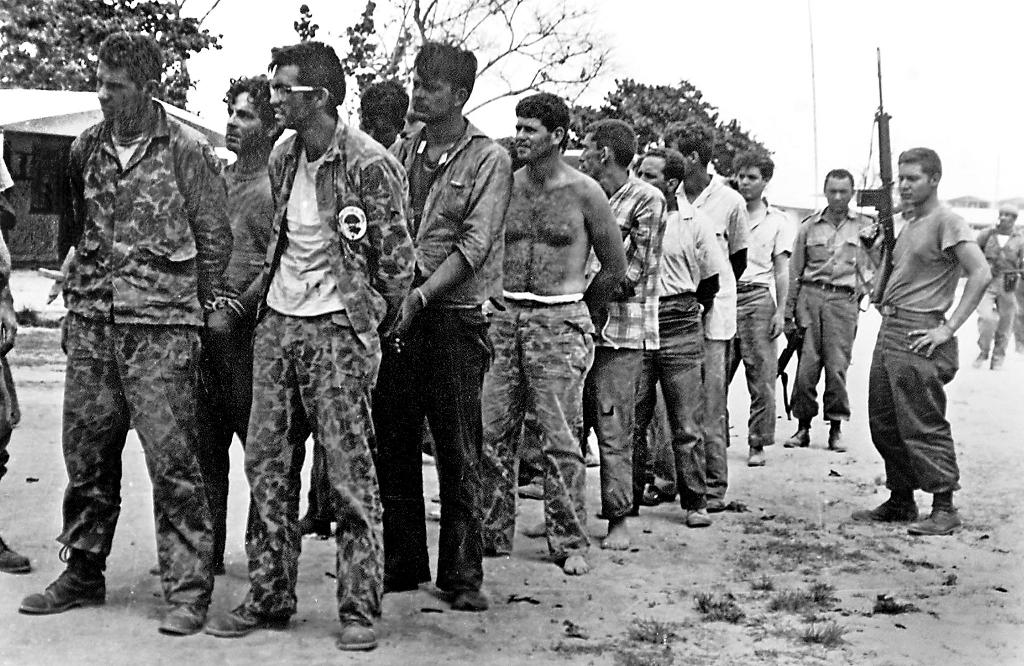
The landing began on April 17. Kennedy canceled the planned second air strike, and within days Brigade 2506 was surrounded. Some 1,200 brigade members were taken prisoner and were not released until December 1962, in exchange for about $53 million in food and medicine.
The failure of the invasion, the decisions about military support and the consequences for the members of Brigade 2506 caused deep controversy. Many Cubans felt abandoned. For those who risked their lives hoping to recover their homeland, that defeat was much more than a military failure.
However, I believe it is also necessary to examine the conditions under which the operation took place.
Guatemala had served as a precedent for American covert interventions, especially with the overthrow of Jacobo Árbenz in 1954. But Cuba presented different geographic, military and political circumstances. Guatemala had land borders; Cuba was an island, and any landing required particularly complex support and supply.
Were those differences given enough consideration? To what extent did President Kennedy understand all the risks of the project he had inherited?
These questions deserve an analysis that goes beyond blaming the president alone.
Operation Mongoose and the Operation Northwoods proposals
After the Bay of Pigs failure came Operation Mongoose, a program of covert actions against Fidel Castro’s government. During that period, proposals were developed for sabotage, psychological operations and actions meant to weaken the Cuban regime.
There is another precedent I consider essential: the so-called Operation Northwoods. On March 13, 1962, Gen. Lyman L. Lemnitzer, chairman of the Joint Chiefs of Staff, signed and delivered to Defense Secretary Robert McNamara a secret memorandum titled “Justification for U.S. Military Intervention in Cuba.” It proposed fabricated or simulated incidents to blame Castro and justify an invasion.
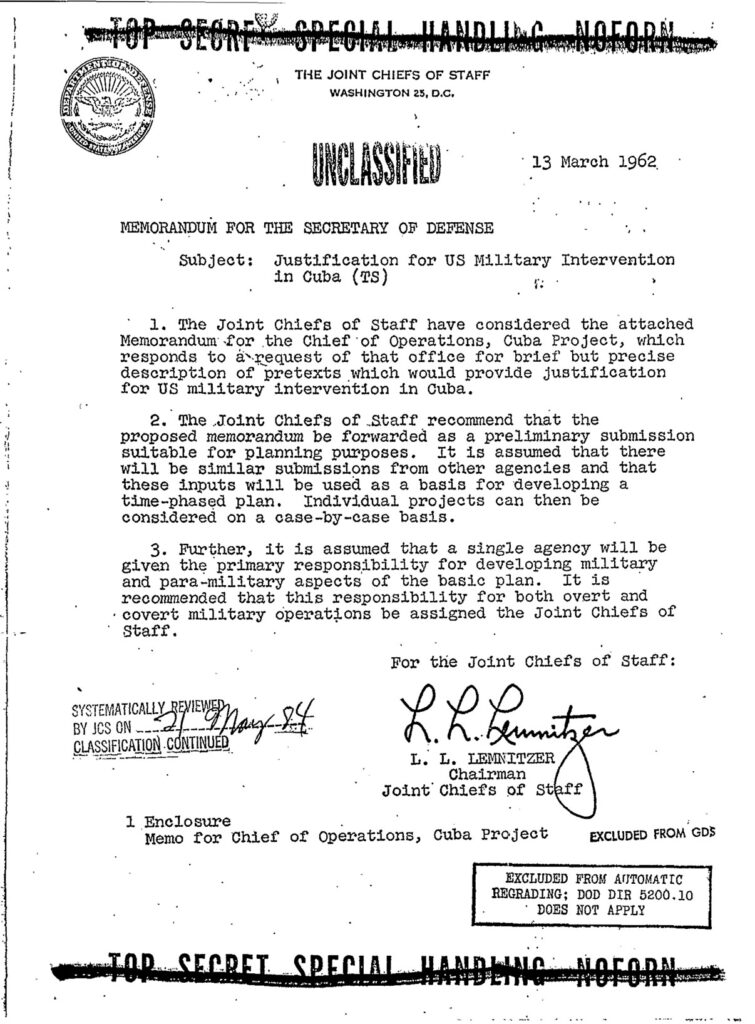
Among the actions listed in the declassified document are these:
- Stage a series of incidents at the Guantánamo Naval Base: spread rumors through clandestine radio, dress friendly Cubans as Castro’s soldiers to fake an attack, start riots at the main gate, blow up ammunition and burn aircraft inside the base.
- Blow up a U.S. ship in Guantánamo Bay and blame Cuba, in a “Remember the Maine” style incident. The text itself expected casualty lists in U.S. newspapers to cause “a helpful wave of national indignation.”
- Develop a fake “Communist Cuban terror campaign” in Miami, in other Florida cities and even in Washington, with plastic bombs in “carefully chosen spots.”
- Sink a boatload of Cubans en route to Florida, “real or simulated,” and foster attempts on the lives of Cuban refugees in the United States.
- Simulate “Cuban” attacks against neighboring countries, such as night raids to burn sugarcane fields in the Dominican Republic with Soviet-made incendiaries.
- Use aircraft disguised as MiGs, flown by American pilots, to harass civilian flights, attack ships and destroy unmanned U.S. military aircraft.
- Replace a charter plane carrying college students with an identical drone and blow it up over Cuba, so it would appear to have been shot down by Cuban fighters.
These were proposed plans, not executed acts. The declassified documents show how far certain proposals went within the U.S. military structure.
Those proposals were neither approved by Kennedy nor carried out. Still, their existence raises deeply disturbing questions about the methods some sectors were willing to consider.
For me, the gravity of these proposals lies not only in their content, but in what they reveal about the willingness of certain sectors to use fear, manipulation and the sacrifice of innocent people as tools of international policy.
What would have happened if some of those proposals had been accepted? How many lives would have been exposed to a manufactured confrontation?
Kennedy did not approve Operation Northwoods. Months later, in September 1962, Lemnitzer left the chairmanship of the Joint Chiefs and was sent to Europe as NATO commander. These facts deserve an important place when analyzing Kennedy’s relationship with the military and intelligence establishment.
Historical responsibility
For decades Cubans have demanded an explanation for the failure of that invasion. That demand is legitimate. So is the right of Americans to know the proposals and operations drawn up in the name of their national security.
The Kennedy presidency was marked by enormous international tension. The Cold War turned Cuba into one of the most dangerous stages of the confrontation between the United States and the Soviet Union. In that context, a presidential decision could make the difference between a diplomatic crisis and a war with unpredictable consequences.
That is why I consider it unfair to reduce the whole story of the Bay of Pigs to an accusation of betrayal against John F. Kennedy, without examining the background, the responsibilities of the agencies involved and the proposals that later came to light.
In December 2016, the U.S. Congress awarded the Congressional Gold Medal to the members of the OSS, in recognition of their contribution during World War II. The OSS had disappeared decades earlier, but its legacy remained in the history of American intelligence, and the CIA, heir to part of that experience, continued to play a decisive role in international affairs.
And here my question arises again: who really controls those who have the power to carry out secret operations capable of compromising a nation?
I do not intend to absolve Kennedy of his mistakes. I want his responsibility to be examined alongside that of all the participants. History cannot be written only from the disappointment of a defeat, nor from the convenience of those who have managed the information for years.
Cubans deserve to know the truth about the Bay of Pigs, those responsible and the decisions that determined its outcome.
John F. Kennedy: America First and the defense of innocent lives
John F. Kennedy has been accused of betraying Cubans at the Bay of Pigs. I understand the pain and disappointment of those who placed their hopes in that invasion, especially the members of Brigade 2506.
But I believe the time has come to vindicate the courage of that president and examine his decisions with greater historical fairness.
Kennedy chose America First. In 1961 he refused to turn the invasion into an open U.S. war, and a year later he rejected a plan that contemplated sacrificing innocent Americans and Cubans to manufacture a pretext for war. In doing so he defended the people who had elected him and also protected those who could have become victims of those operations.
From my perspective, that decision was not a betrayal of the Cuban people. It was a demonstration of responsibility and humanity.
To the Cubans who still consider him a traitor, I suggest examining these historical documents and asking themselves whether refusing to sacrifice innocent lives can truly be called betrayal.
That, for me, is the historical debt we owe John F. Kennedy: to recognize his courage without forgetting Cuba’s suffering or the responsibilities of those who took part in those events.
Because no president should stand above history, but neither should he carry, alone, the decisions and interests of an entire system.
Sources
- National Security Archive: Pentagon Proposed Pretexts for Cuba Invasion in 1962 (Northwoods memorandum)
- National Security Archive: Bay of Pigs, 40 Years After (chronology)
- Public Law 114-269: Congressional Gold Medal for the OSS (2016)
📱 Get the What US News app

Scan the code with your phone or go to whatusnews.com/app. Free for Android and iPhone. How to install it.
Conversation